PLC handshakes
Coordinate part arrival, machine-ready states, marking and release.
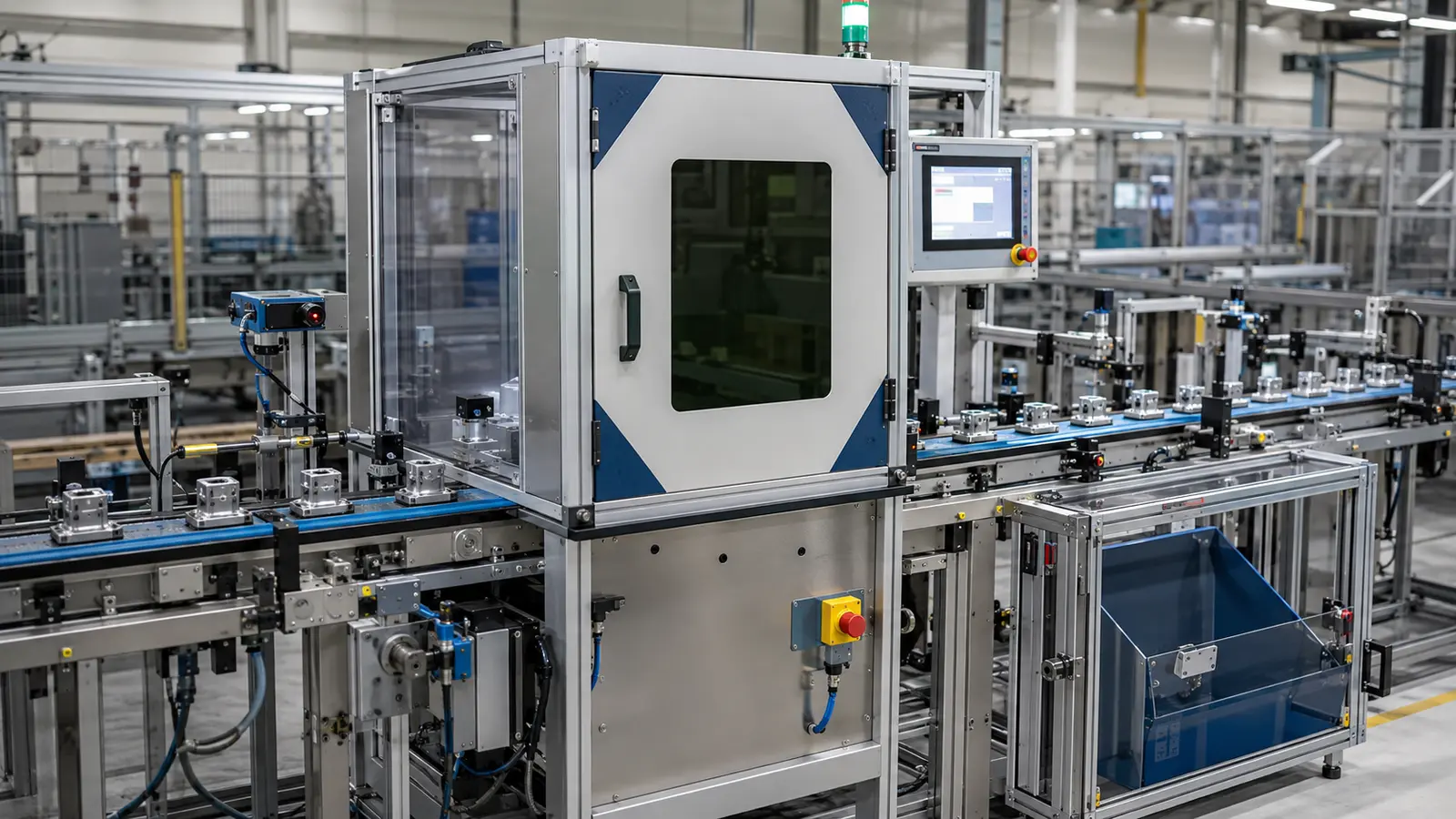
Turnkey marking automation
Connect permanent marking with conveyors, machine controls, production data, part handling, vision inspection and automatic reject systems.
A complete production process
Oxford Traceability considers the complete sequence: detect the component, confirm identity, position it, apply the mark, verify the result, record the outcome and safely handle any failure. The laser is engineered as part of the line rather than treated as a stand-alone device.
Request a sample marking trialCoordinate part arrival, machine-ready states, marking and release.
Receive product recipes and variable content from factory systems.
Use conveyors, stops, lifts, fixtures or robotics to present the part.
Inspect the result and route failed components under controlled logic.
Controls & connectivity
A clear control philosophy prevents ambiguous line behaviour. We agree which system owns the product recipe, when variable data becomes valid, how acknowledgements are exchanged and what happens after a timeout or failed mark.
An agreed signal and data specification helps the laser, line controls and factory systems operate as one process.
Safety & product handling
Laser safety, machine access, fume extraction, component motion and maintenance tasks must be considered together. The final cell can include interlocked guarding, safe access, monitored reject handling and clear operator recovery steps.
Product flow, available space, controls, services and maintenance access are checked before the integration layout is finalised.
Application questions
Every material and production process is different. We will help you turn the marking requirement into a practical specification.
Call 01865 362785Yes. The interface can use agreed hardwired signals or suitable industrial communications, depending on the existing controls and the data that must be exchanged.
Yes, where the mark and presentation support inspection. The camera can check presence, decode content and send pass/fail information to the control system.
The response is designed around process risk. Options include stopping the line, holding the component, automatic rejection, operator intervention and recording the failure.
Start your marking trial
Share the material, mark content and production rate. We will help you define the right fibre laser marking system.
Your application
Tell us what you need to mark and we will come back to you.