Mark requirement
Content, size, contrast, depth and durability.
Specify before you compare quotations
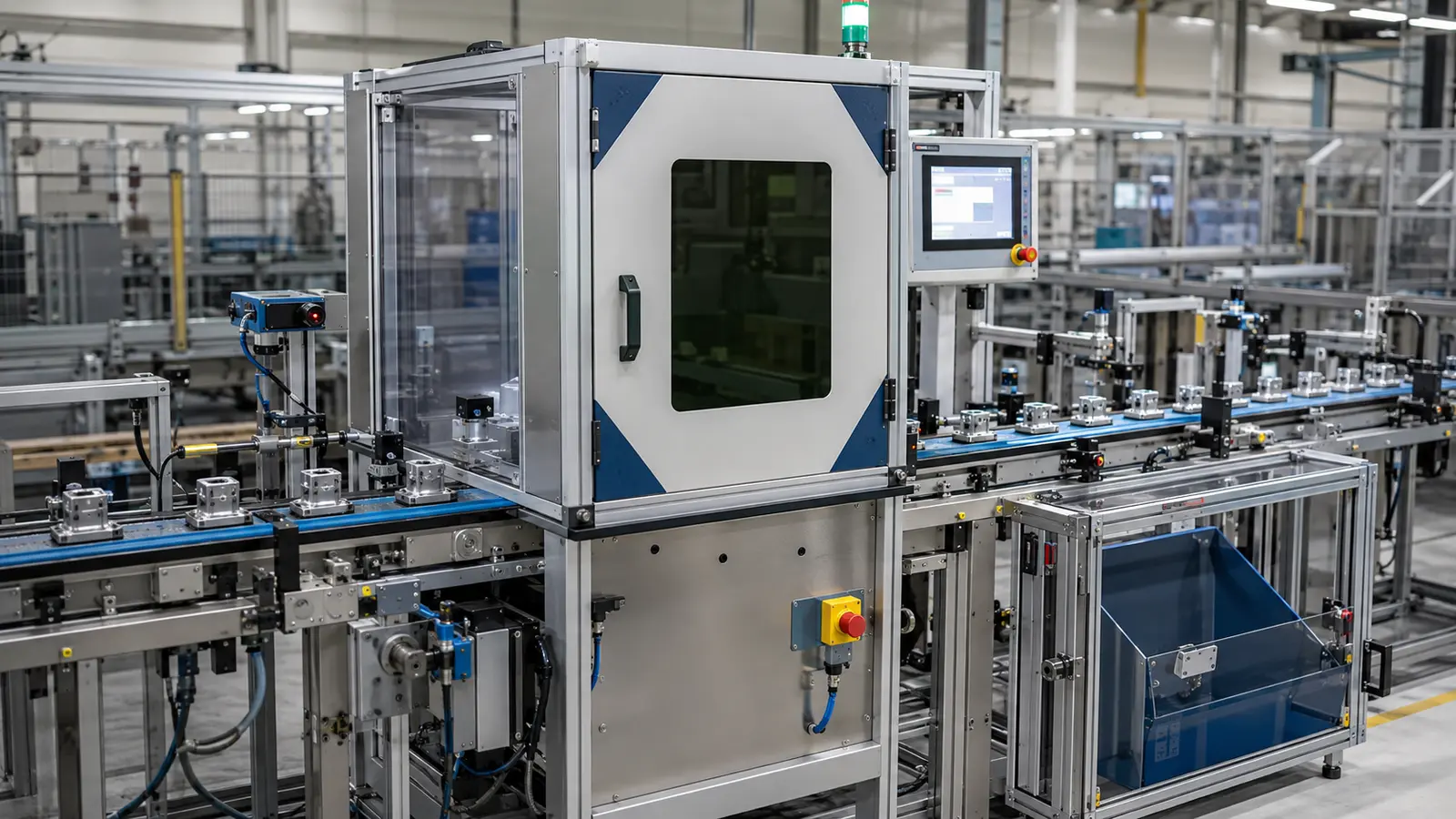
Compare laser source, power, marking field, enclosure, fixtures, extraction, software, verification and integration on the basis of your real production requirement.
Buying an industrial laser marker
A fibre laser marking machine’s cost depends on the laser source and power, marking field, enclosure, focus control, tooling, extraction, software, data connection, vision and automation. Compare quotations against a common application specification rather than wattage alone.
A reliable budget begins with marked samples, an agreed acceptance standard and a realistic production cycle.
Content, size, contrast, depth and durability.
Material, finish, geometry and location tolerance.
Volume, cycle, loading, data and verification.
Training, support, spares and future product range.
Quotation checklist
Ask every supplier to state what is included, what remains optional and which assumptions were used.
Power selection
Higher nominal power can support faster, deeper or higher-energy processes, but the best result also depends on pulse characteristics, spot size, lens, material and scan strategy. A 20W, 30W or 50W label is not a complete specification.
A sample that looks good after an unrestricted laboratory trial may not be suitable for the required production rate.
Price & total cost
A credible quotation should identify the laser, enclosure, computer and software, fixture, rotary axis, extraction, guarding, controls, vision, installation, training and validation separately. This makes competing proposals easier to compare and exposes missing scope.
The least expensive purchase can become costly if it needs later enclosure, tooling, extraction or data work before production can use it.
Marking or engraving
“Laser marking”, “etching” and “engraving” are often used loosely. State whether you need a surface colour change, coating removal, anneal-style contrast or a recessed mark, together with acceptable depth, appearance and functional limits.
Photographs help with initial discussion, but signed samples and objective criteria give both sides a dependable acceptance reference.
Buyer questions
Send enough detail for suppliers to quote the same production requirement.
Request a project reviewThe cost varies substantially with source, power, marking field, enclosure, fixtures, extraction, software, vision and automation. Oxford Traceability provides an application-specific quotation after reviewing the part, mark and production requirement.
Choose power after testing the material and required mark at the target cycle. Higher power may help some fast or deeper processes, but optics, pulse characteristics, field size and process settings are equally important.
MOPA is worth testing when wider pulse control may improve contrast, surface finish or heat management. It is not automatically necessary for routine marking that a standard pulsed fibre source already performs well.
Specify the largest required layout and the smallest required feature. A larger field is convenient but changes optical geometry and may not be ideal for very small characters or compact 2D codes.
Provide representative parts, material grade, finish, exact mark artwork or data, mark position, cycle rate, loading method, data source, verification requirement and details of the installation environment.
Start your marking trial
Share the material, mark content and production rate. We will help you define the right fibre laser marking system.
Your application
Tell us what you need to mark and we will come back to you.