High-contrast identification
Create light-on-dark or dark-on-light results where the polymer formulation supports it.
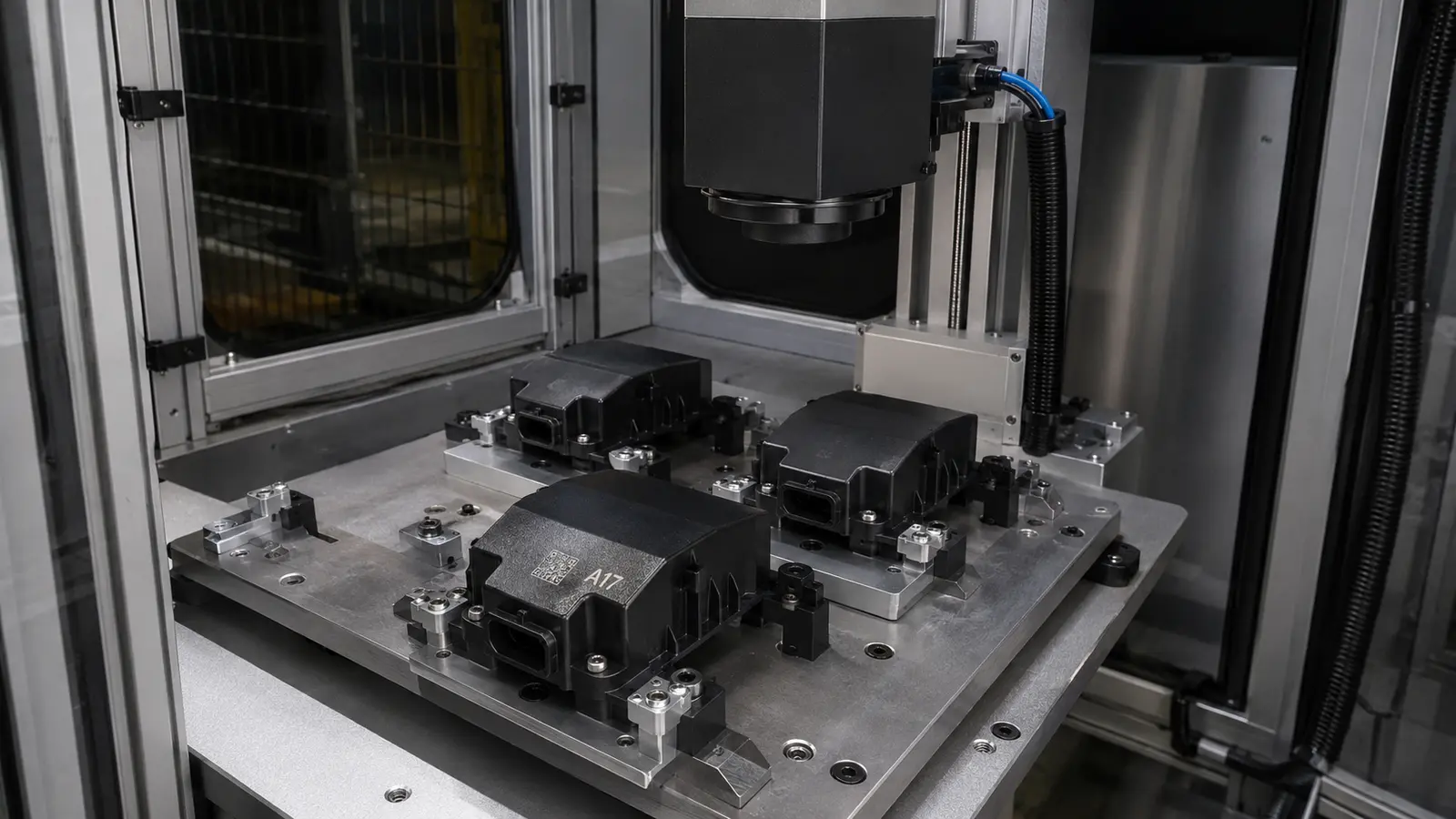
High-contrast component identification
Apply permanent part references, serial numbers, logos and machine-readable codes to suitable moulded housings and technical polymer components.
Prove material response
Two visually identical mouldings can react very differently if their resin, filler, pigment or additive package changes. We test current production parts to establish contrast, surface effect, heat response and marking window before the machine is specified.
Request a sample marking trialCreate light-on-dark or dark-on-light results where the polymer formulation supports it.
Mark without a printing pad, label applicator or direct mechanical contact.
Add serial numbers, dates, batches and unique codes to individual mouldings.
Build the marking process into a workstation, assembly cell or automated line.
Polymer suitability
Laser marking can create a colour change, controlled foaming or another visible surface response in suitable plastics. The achievable contrast and cycle time depend on the exact material recipe, mould texture and colour.
If a supplier changes resin grade, masterbatch or additive content, repeat the marking trial before releasing the revised component.
Fixtures & presentation
Custom nests can support the part without scratching visible faces, while sensors confirm presence and orientation. For automated cells, handling can be designed around cooling time, moulding variation and downstream assembly.
A small sample set helps reveal normal variation in colour, texture, flatness and moulding quality.
Application questions
Every material and production process is different. We will help you turn the marking requirement into a practical specification.
Call 01865 362785No. Suitability depends on the polymer and additives as well as the required appearance. Some applications may suit another laser wavelength, which is why representative sample testing is essential.
The process and parameters are selected to create the required visible result while controlling surface effect and heat input. Functional or cosmetic acceptance criteria should be agreed during trials.
Yes. A system can be integrated with conveyors, robots, assembly stations or moulding-machine handling, with sensors and vision used to confirm the correct part and mark.
Start your marking trial
Share the material, mark content and production rate. We will help you define the right fibre laser marking system.
Your application
Tell us what you need to mark and we will come back to you.