Controlled heat input
Tune pulse behaviour for sensitive surfaces and fine features.
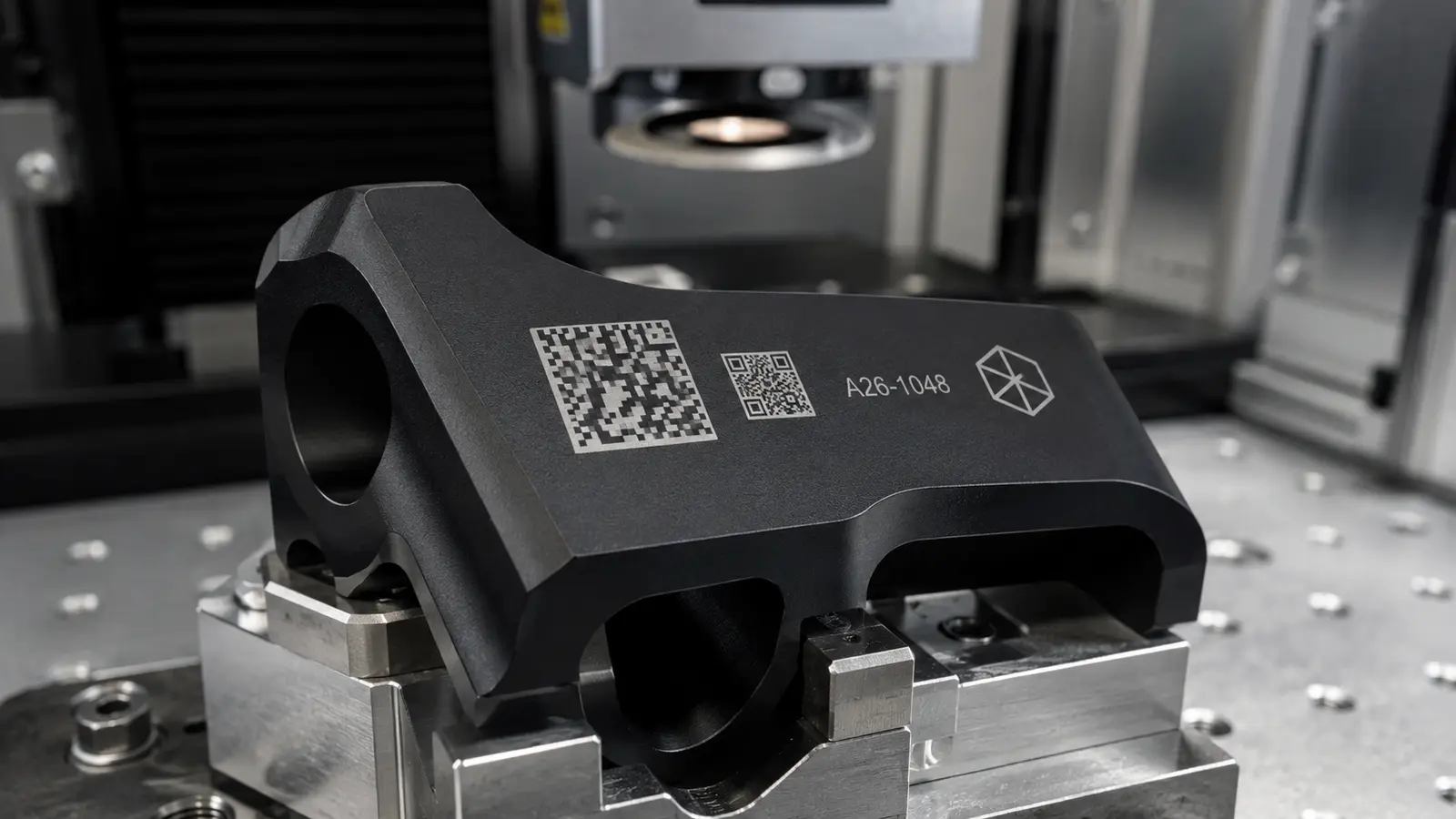
More control over the laser pulse
Specify a wider pulse-width range for demanding contrast, surface finish and heat-sensitive marking applications on metals and suitable plastics.
MOPA explained
A MOPA fibre laser allows pulse width and repetition rate to be adjusted across a wider operating range than a conventional fixed-pulse source. That extra control can improve contrast or reduce unwanted heat effects on certain metals and engineered plastics.
The correct source still depends on the actual material, finish, mark and cycle time. We compare settings on representative samples before recommending MOPA.
Tune pulse behaviour for sensitive surfaces and fine features.
Explore dark marking on suitable stainless steels and coatings.
Test a wider process window on compatible engineered polymers.
Combine fixed graphics, serialisation and machine-readable codes.
Source comparison
Neither source is automatically better. The right choice is the source that creates an accepted mark reliably at the required production rate.
Metal applications
MOPA sources are often considered for high-contrast marking on stainless steel, fine detail, surface-sensitive components and applications where the thermal effect must be carefully managed. Alloy composition, surface finish, preparation and required cycle time all affect the outcome.
A visually similar alloy or polymer can respond differently. Representative samples prevent the source from being chosen on assumptions.
Plastic applications
On compatible polymers, controlled pulse settings may improve foaming, colour change or surface response while limiting heat damage. Results depend heavily on resin, pigment, fillers and laser-sensitive additives, so material trials are essential.
Trade names alone are rarely enough. Resin grade, colour masterbatch, additives and surface texture all help us define a useful trial.
MOPA questions
We establish the answer with representative components and measurable acceptance criteria.
Request a sample trialMOPA means master oscillator power amplifier. In a marking system it provides a wider adjustable pulse-width and frequency range, allowing the process to be tuned more precisely for the material and required finish.
No. A standard pulsed fibre source is suitable for many industrial marking tasks. MOPA is valuable when its wider pulse control produces a result or process window that the standard source cannot deliver.
It can produce very dark marks on suitable stainless steels under controlled conditions, but alloy, finish, preparation, optics and cycle requirement must be tested. A sample trial is the correct way to confirm the achievable result.
Many engineered plastics can be trialled, but not every polymer is suitable. Resin chemistry, pigment and additives determine whether the process creates acceptable contrast without unacceptable surface damage.
Start your marking trial
Share the material, mark content and production rate. We will help you define the right fibre laser marking system.
Your application
Tell us what you need to mark and we will come back to you.